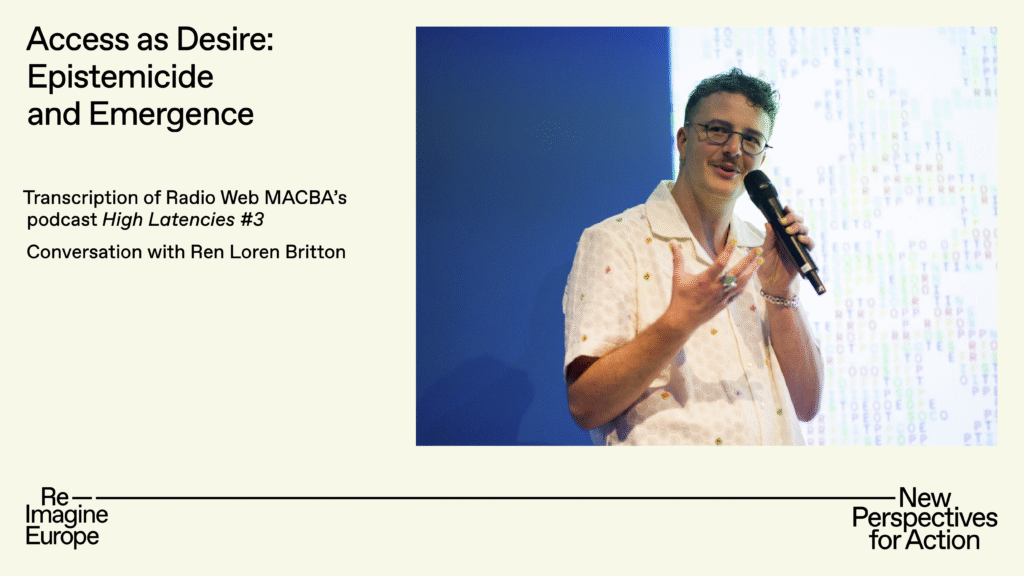
Access as Desire: Epistemicide and Emergence
<p>Stretching time until it trembles, staying with the slipperiness of lived experience, embracing non-linear temporalities, and insisting that joy and fun are necessary technologies of survival are part of Ren Loren Britton’s critical and radical pedagogy. Against the logics of efficiency and assimilation, Ren calls for modes of being-together that value other temporalities and ways of feeling—where needs are not burdens but signals of interdependence, where data can be tender, and where the archive might become a site of relational vulnerability.</p> <p>Ren Loren Britton’s artistic research moves through the molten intersections of trans*feminisms, technoscience, disability justice, and radical pedagogy. Working within collaborative constellations such as MELT (with Iz Paehr) and FansBenderPresents (with Rosen Eveleigh), among others, their work invites us to engage in processes of unlearning, reimagining, and reconfiguring access—not as compliance or checklist, but as a rehearsal of desire and relation, building infrastructures of care. In their words, this practice draws inspiration from Indigenous epistemologies and thinks with trans* and Disabled experiences, working against epistemicide, i.e. the willful killing of ways of knowing.</p> <p>Ren walks us through trans* and Disabled lineages, their erasure and resurgence, tracing how cultural memory holds both the burden of remembering and the care of unforgetting. The conversation wanders through crip technoscience, access riders and servers, and braver spaces that acknowledge that safety is never universal, alongside the affective infrastructures that sustain care across difference. In the middle of too much data—and not enough—crip technologies of knowing, and of feeling knowledge into being, offer other ways of sensing the world.</p>
Authors: Jara Rocha, Anna Ramos
Sound Designer: pantea
Photographer: Boudewijn Bollmann, Daniel Jarosch, Gemma Planell, Isaac Sanjuan, Franz Warmhof
Transcriber: Roc Jiménez de Cisneros
Project Coordinator: Annette Wolfsberger
Graphic Designer: Henri Kutsar