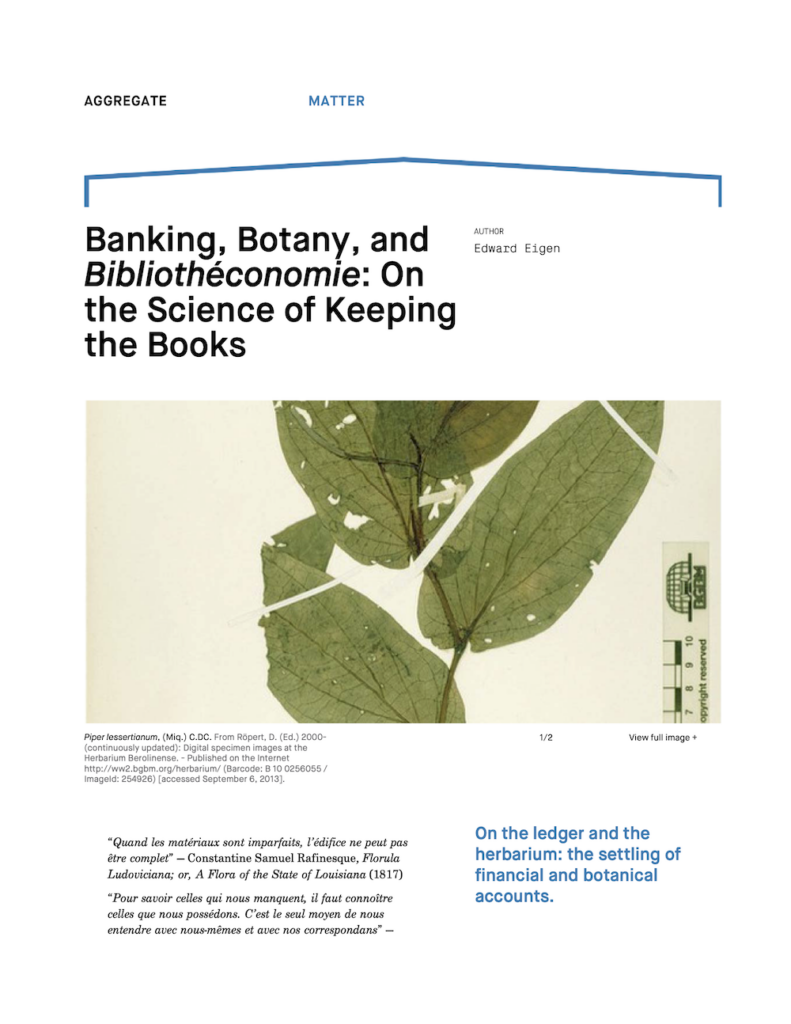
Banking, Botany, and Bibliothéconomie: On the Science of Keeping the Books
<p>On the ledger and the herbarium: the settling of financial and botanical accounts.</p> <p>From the perspective of the twenty-first century, the age of digital media and TCP/IP protocol architecture, the 1989 discovery of the manuscript of Jules Verne’s <em>Paris in the Twentieth Century</em> (1863) in a locked safe perhaps appears more dramatic than the unpublished novel’s retrospectively tepid dystopian prophecies. Yet its narrator Michel Jérôme Dufrénoy’s employment in the banking house of Casmodage et Cie. provides unexpected insight into what it meant to keep the books in nineteenth-century France. The novel is set in a Paris of the 1960s, when literary culture was the object of scorn when it was not unregretfully forgotten. But like so many visions of the future, Verne’s is a skeptical portrait of his own time. Michel is met with taunts and sarcasm when he receives first prize for Latin verse upon completing his studies with the Société Générale de Crédit Instructionnel. This vast apparatus had no fewer than 157,342 students, to whom information was imparted by mechanical means, most all of them receiving instruction in science, technology, and the instruments of finance…</p>
Authors: Edward Eigen
Aggregate Architectural History Collaborative