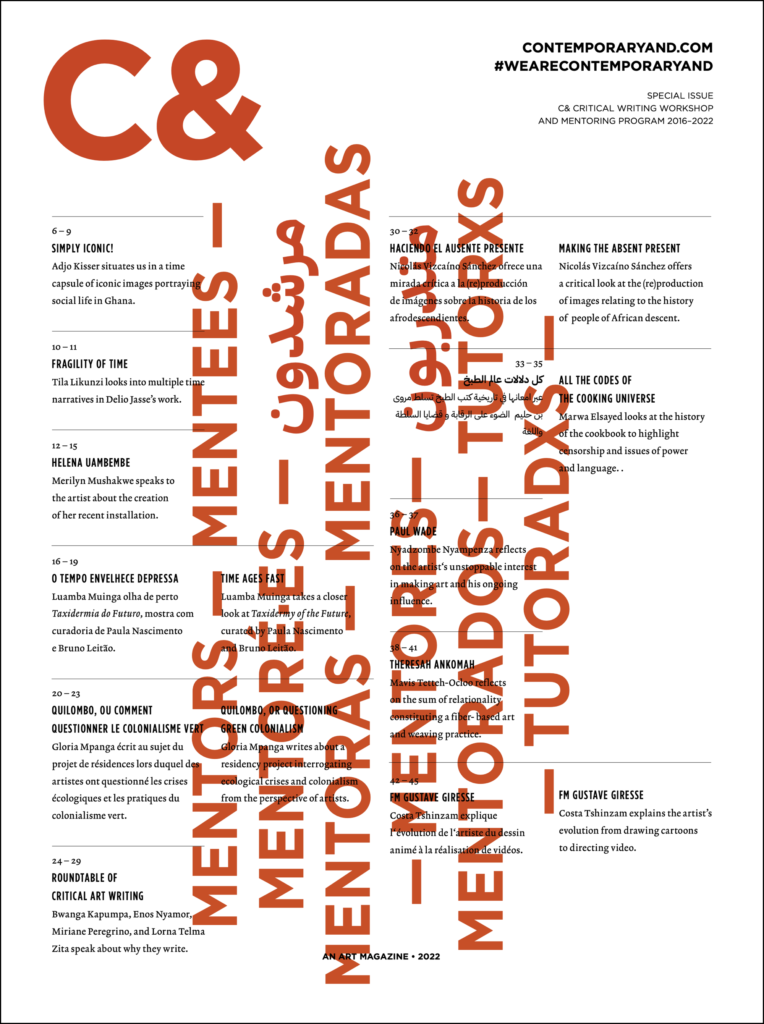
C& Magazine Special Edition: Art of Critique
<p>This print issue is a celebration and commemoration of the work that has been produced through the mentoring program. It brings together a selection of ten texts written between 2017 and 2022 around art, exhibitions, and curatorial practices from the contexts in which the writers live or work. Rather than reflecting a single preoccupation with legibility or translation, the texts give indication of what shapes the organization and distribution of local or contextual art practices, including, among many other things, language, infrastructure, and individual affinities.</p> <p>Adjo Kisser situates us in a time capsule of iconic images from the period marking Ghana’s post-independence. The idea of “time-preciseness” comes our way through Tila Likunzi’s view of Délio Jasse’s exhibition Fragility of Time. Both writers, the artist, the photographic archive, and exhibition produce multiple relations to time and place. In an interview with Merilyn Mushakwe, Helena Uambembe asks the artist about the creation of her installation work What you see is not what you remember, a recreation of living moments that encapsulate points in time within history. And what time is it?</p> <p>Luamba Muinga writes, “it is the time of Black emergence from colonialism to self-affirmation, before a time that ages these issues, given the volatility of discourses, making them ghosts of reflection.” Reiterating that urgency, Nicolás Vizcaíno Sánchez calls attention to strategies for repositioning Black bodies in the (re)production of images on the history of people of African descent. Gloria Mpanga brings us back to the question of power in the use people make of other people’s land, approaching colonial histories by looking at a residency project linking works of artists from cities with very different contexts of production, language, and experience. Language continually saturates the living being as well as illustrating conditions of production. Marwa Elsayed shows how the cookbook is a form of resistance through which Marwa Benhalim casts a view on issues of power and language. Elsayyed highlights collaboration and other strategies Benhalim used to respond to the COVID-19 shutdown.</p> <p>The roundtable with Bwanga Kapumpa, Enos Nyamor, Miriane Peregrino, and Lorna Telma Zita focuses on why the participants write, their practices in recent years, and the state of art writing. Nyadzombe Nyampenza looks at an exhibition that reflects Paul Wade’s unstoppable interest in making art and his ongoing influence on the country’s contemporary art scene. Mavis Tetteh- Ocloo creates a portrait of Theresa Ankoma’s fiber-based art and weaving practices as well as her interest in object biographies. Costa Tshinzam writes about experimentation in FM Gustave Giresse’s work, witnessing the power that new technologies have to revolutionize contemporary artistic practices.</p> <p>Together these writers position art and writing as practice, theory, vigilance, responsibility, poetry, and life – re-invented in each instance.</p>
Editors: Julia Grosse, Yvette Mutumba, Rose Jepkorir, Theresa Sigmund, Luz Gyalui, Olivia Buschey
Contributors: Costa Tshinzam, Enos Nyamor, Nyadzombe Nyampenza, Luamba Muinga, Miriane Peregrino, Tila Likunzi, Marwa Elsayyed, Nicolás Vizcaíno Sánchez, Adjo Kisser, Mavis Tetteh-Ocloo, Merilyn Mushakwe, Bwanga Kapumpa, Gloria Mpanga, Lorna Telma Zita
Copy-editors: Jenifer Evans, Simon Cowper, Imen Zarrouk, Sara C. Hanaburgh, Myriam Ochoa-Suel
Translators: Jenifer Evans, Simon Cowper, Imen Zarrouk, Sara C. Hanaburgh, Myriam Ochoa-Suel
Designers: Britta Rogozinski, SHIFT Design
Part of: C& Magazine
ISSN: 2701-3375